Mother Teresa 3

Thoughts of a woman who knew God because she did what Jesus said.

Chosen

“You have not chosen me, but I have chosen you.” Jesus has chosen us for himself. We belong to him. Let us be so convinced of this belonging that we allow nothing, however small, to separate us from his love.

Greater Things

We must know that we have been created for greater things, not just to be a number in the world, not just to go for diplomas and degrees, this work and that work. We have been created in order to love and to be loved.

Spoiled

No one spoils us as much as God Himself. See the wonderful gifts he has given us freely? You can all see — if God were to take money for your sight what would happen? Continually we are breathing and living on oxygen we did not pay for.

More

Home

Pascal

Some thoughts of Blaise Pascal

Impossible

But it is impossible that God should ever be the end, if He is not the beginning. We lift our eyes on high, but lean upon the sand; and the earth will dissolve, and we shall fall while looking at the heavens.

Nature

Nature is an infinite sphere of which the center is everywhere and the circumference nowhere.

By One Man

The true religion teaches us that by one man all was lost, and the bond broken between God and us, and that by one man the bond is renewed.

More

Home

Mother Teresa 2

Thoughts of a woman who knew God because she did what Jesus said.

No Limit

There is no limit to God’s love. It is without measure, and its depth cannot be sounded. This is shown by his living and dying among us. Now turn the same picture around. There must be no limit to the love that prompts us to give ourselves to God, to be the victim of His unwanted love, that is the love of God that has not been accepted by men.

Tender

God loves us with a tender love. That is all that Jesus came to teach us, the tender love of God. “I have called you by name, you are Mine.”

Remember

Remember that when your heart feels restless, when your heart feels hurt, when your heart feels like breaking – then remember, “I am precious to Him. He loves me. God loves me.” And to prove that love he died on the cross.

More

Home

Mother Teresa

Thoughts of a woman who knew God because she did what Jesus said.

Peace

Being God, Jesus became like us in every way except sin. And he proclaimed clearly that he had come to bring good news. That good news was God’s peace to all men of good will. That peace is something which is fundamental to the satisfaction of our most basic desires. It is a peace of the heart.

To Feel

In heaven, everything was beautiful – yet, what attracted Jesus to earth? The Son of God wanted to feel what it meant to be a human being; to be locked up for nine months, so dependent on a mother. That is why we say, “He, being rich, became poor.”

To Show Us

As if it were not enough – as if it were not enough to become man – Jesus died on the cross to show us his great love. He died for you and for me.

More

Home

True Religion – Pascal

Men are born so averse to the love of God, and it is so necessary, that we must be born guilty, or God would be unjust.

The true religion must have as a characteristic the obligation to love God. This is very just, and yet no other religion has commanded this; ours has done so. It must also be aware of human lust and weakness; ours is so. It must have adduced remedies for this; one is prayer. No other religion has asked of God to love and follow Him.

Pascal-Quote-1

He who hates not in himself his self-love, and that instinct which leads him to make himself God, is indeed blinded. Who does not see that there is nothing so opposed to justice and truth? For it is false that we deserve this, and it is unfair and impossible to attain it, since all demand the same thing. It is, then, a manifest injustice which is innate in us, of which we cannot get rid, and of which we must get rid.

Yet no religion has indicated that this was a sin; or that we were born in it; or that we were obliged to resist it; or has thought of giving us remedies for it.

Pascal-Quote-2

The true religion teaches our duties; our weaknesses, pride, and lust; and the remedies, humility and mortification.

The true religion must teach greatness and misery; must lead to the esteem and contempt of self, to love and to hate.

Pascal-Quote-3

If it is an extraordinary blindness to live without investigating what we are, it is a terrible one to live an evil life, while believing in God.

Experience makes us see an enormous difference between piety and goodness.

Pascal-Quote-4

Against those who, trusting to the mercy of God, live heedlessly, without doing good works.—As the two sources of our sins are pride and sloth, God has revealed to us two of His attributes to cure them, mercy and justice. The property of justice is to humble pride, however holy may be our works, et non intres in judicium, and the property of mercy is to combat sloth by exhorting to good works, according to that passage: “The goodness of God leadeth to repentance,” and that other of the Ninevites: “Let us do penance to see if peradventure He will pity us.” And thus mercy is so far from authorising slackness, that it is on the contrary the quality which formally attacks it; so that instead of saying, “If there were no mercy in God we should have to make every kind of effort after virtue,” we must say, on the contrary, that it is because there is mercy in God, that we must make every kind of effort.

Pascal-Quote-5

It is true there is difficulty in entering into godliness. But this difficulty does not arise from the religion which begins in us, but from the irreligion which is still there. If our senses were not opposed to penitence, and if our corruption were not opposed to the purity of God, there would be nothing in this painful to us. We suffer only in proportion as the vice which is natural to us resists supernatural grace. Our heart feels torn asunder between these opposed efforts. But it would be very unfair to impute this violence to God, who is drawing us on, instead of to the world, which is holding us back. It is as a child, which a mother tears from the arms of robbers, in the pain it suffers, should love the loving and legitimate violence of her who procures its liberty, and detest only the impetuous and tyrannical violence of those who detain it unjustly. The most cruel war which God can make with men in this life is to leave them without that war which He came to bring. “I came to send war,” He says, “and to teach them of this war. I came to bring fire and the sword.” Before Him the world lived in this false peace.

pascal-statue1

Home

The Body – Pascal

God having made the heavens and the earth, which do not feel the happiness of their being, He has willed to make beings who should know it, and who should compose a body of thinking members. For our members do not feel the happiness of their union. How happy they would be if they saw and felt it! But for this they would need to have intelligence to know it, and good-will to consent to that of the universal soul. But if, having received intelligence, they employed it to retain nourishment for themselves without allowing it to pass to the other members, they would hate rather than love themselves; their blessedness, as well as their duty, consisting in their consent to the guidance of the whole soul to which they belong, which loves them better than they love themselves.

pascal-quote-6

To be a member is to have neither life, being, nor movement, except through the spirit of the body, and for the body.

The separate member, seeing no longer the body to which it belongs, has only a perishing and dying existence. Yet it believes it is a whole, and seeing not the body on which it depends, it believes it depends only on self, and desires to make itself both center and body. But not having in itself a principle of life, it only goes astray, and is astonished in the uncertainty of its being; perceiving in fact that it is not a body, and still not seeing that it is a member of a body. In short, when it comes to know itself, it has returned as it were to its own home, and loves itself only for the body. It deplores its past wanderings.

It cannot by its nature love any other thing, except for itself and to subject it to self, because each thing loves itself more than all. But in loving the body, it loves itself, because it only exists in it, by it, and for it. Qui adhæret Deo unus spiritus est.
(“He who clings to God is one spirit [with Him]”)

pascal-quote-7

The body loves the hand; and the hand, if it had a will, should love itself in the same way as it is loved by the soul. All love which goes beyond this is unfair.

Adhærens Deo unus spiritus est. (“He who clings to God is one spirit [with Him]”) We love ourselves, because we are members of Jesus Christ. We love Jesus Christ, because He is the body of which we are members. All is one, one is in the other, like the Three Persons.

The true and only virtue, then, is to hate self (for we are hateful on account of lust), and to seek a truly lovable being to love. But as we cannot love what is outside ourselves, we must love a being who is in us, and is not ourselves; and that is true of each and all men. Now, only the Universal Being is such. The kingdom of God is within us; the universal good is within us, is ourselves—and not ourselves.
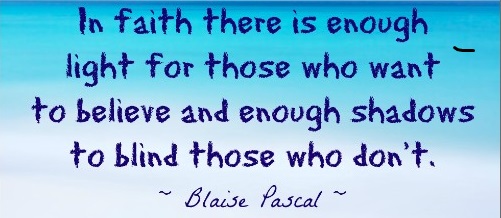
pascal-quote-8

The dignity of man in his innocence consisted in using and having dominion over the creatures, but now in separating himself from them, and subjecting himself to them.

Every religion is false, which as to its faith does not worship one God as the origin of everything, and which as to its morality does not love one only God as the object of everything.

pascal-quote-9

…But it is impossible that God should ever be the end, if He is not the beginning. We lift our eyes on high, but lean upon the sand; and the earth will dissolve, and we shall fall whilst looking at the heavens.

If there is one sole source of everything, there is one sole end of everything; everything through Him, everything for Him. The true religion, then, must teach us to worship Him only, and to love Him only. But as we find ourselves unable to worship what we know not, and to love any other object but ourselves, the religion which instructs us in these duties must instruct us also of this inability, and teach us also the remedies for it. It teaches us that by one man all was lost, and the bond broken between God and us, and that by one man the bond is renewed.

pascal-quote-10

Home